Harnandipuram Ghaziabad Circle Rate 2026: Complete Buyer Guide
Posted By
Harnandipuram Ghaziabad
Date
June 08, 2026
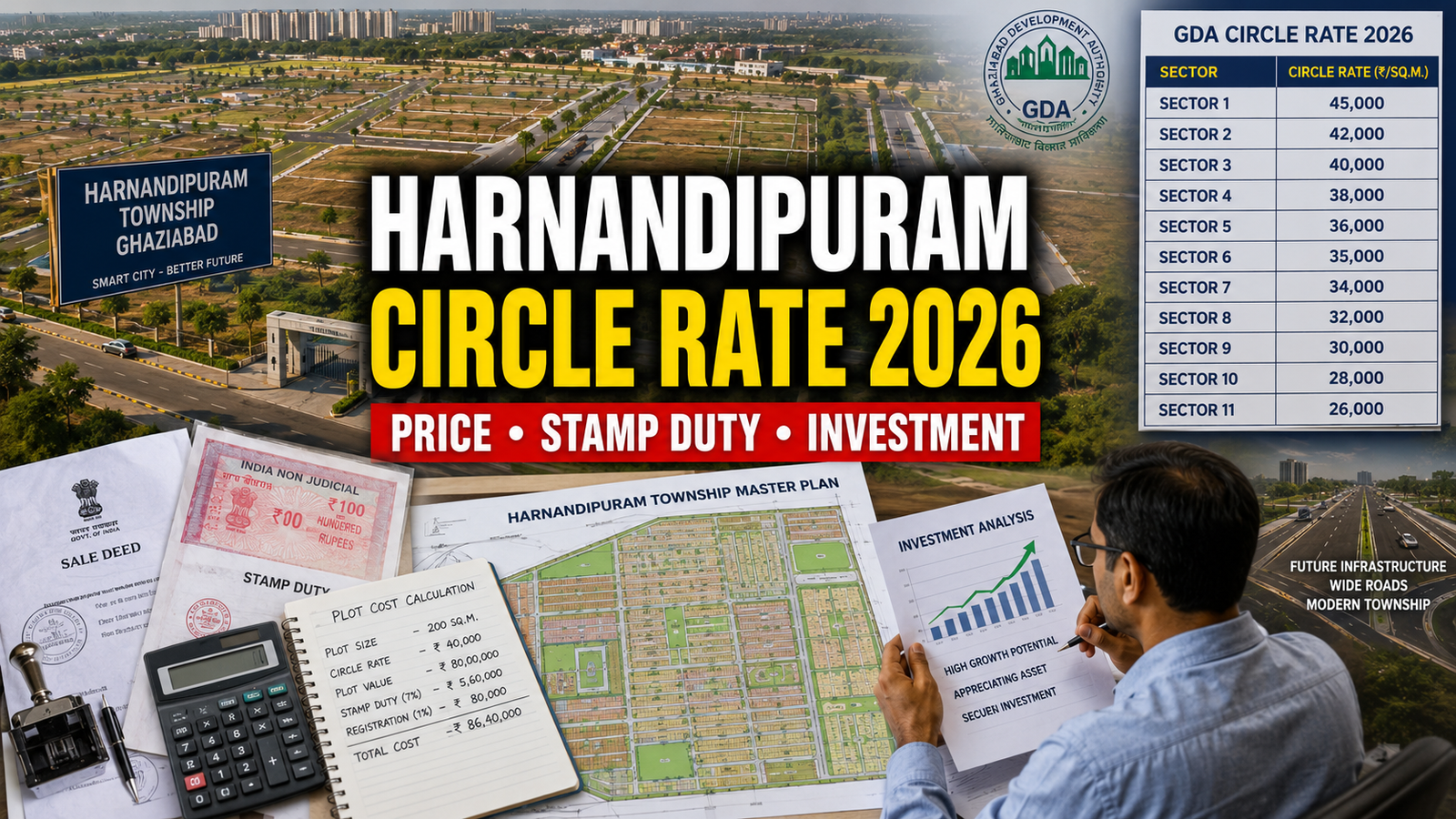
If you're considering buying a plot or investing in the Harnandipuram township project in Ghaziabad, understanding the circle rate is your first critical step. The Harnandipuram Ghaziabad circle rate determines the minimum government-defined value for property registration and directly impacts your stamp duty and registration charges.
In this comprehensive guide, we'll cover everything you need to know about circle rates in Harnandipuram, how they affect property buyers, the latest 2026 rates, registration charges, and why investors should monitor circle rate changes before making investment decisions.
What Is Circle Rate and Why Does It Matter?
The circle rate, also called the ready reckoner rate or minimum value rate, is the minimum price per square metre at which a property can legally be registered in Ghaziabad. The Uttar Pradesh government fixes these rates based on locality, road width, property type, and infrastructure quality.
Here's what makes circle rate crucial for your property transaction:
- Minimum Legal Value: No property can be registered at a price lower than the government-defined circle rate
- Stamp Duty Calculation: Stamp duty and registration fees are charged on the higher of market value or circle rate
- Transaction Transparency: Circle rates prevent undervaluation of properties during registration
- Cost Planning: Knowing circle rates helps you calculate total property acquisition costs accurately
If a property's market price is higher than the circle rate, you pay stamp duty on the higher value. This rule ensures transparency and prevents tax evasion through property undervaluation.
Harnandipuram: The Major Township Project in Ghaziabad
Harnandipuram is not just another locality—it's a transformative township project that will reshape Ghaziabad's real estate landscape. The Ghaziabad Development Authority (GDA) is developing this massive 521-hectare township under the CM Urban Expansion New City Promotion Scheme.
Key Facts About Harnandipuram Township
| Aspect | Details |
|---|---|
| Total Area | 521 hectares (approximately 1,287 acres) |
| Investment Cost | ₹2,384 crore (including stamp duty and registration) |
| Villages Involved | Mathurapur, Shamsher, Champatnagar, Bhanera-Khurd, Nangla Feroze Mohan Nagar |
| Phase 1 Acquisition | 336 hectares from five villages |
| Development Backing | ₹400 crore allocated by UP government for township development |
| Project Type | Mixed-use mega township with housing and infrastructure |
The township will span across five villages, with the largest land acquisition of 192.6 hectares from Nangla Feroze Mohan Nagar. This project represents one of GDA's most significant urban expansion initiatives, transforming rural Ghaziabad into a modern residential hub.
Current Harnandipuram Ghaziabad Circle Rate by Village
The circle rates in Harnandipuram vary significantly across the five villages involved in the township project. Here are the official prevailing circle rates as of 2025-26:
Village-wise Circle Rate Details
| Village | Circle Rate (₹/sqm) | GDA Compensation (4× Rate) | Land Acquisition Area |
|---|---|---|---|
| Mathurapur | ₹1,020 | ₹4,080/sqm | 14.6 hectares |
| Shamsher | ₹1,690 | ₹6,760/sqm | 86.5 hectares |
| Champat Nagar | ₹1,010 | ₹4,040/sqm | Included in phase 1 |
| Bhanera Khurd | ₹1,060 | ₹4,240/sqm | Included in phase 1 |
| Nangla Feroze Mohan Nagar | ₹1,800 | ₹7,200/sqm | 192.6 hectares |
These figures come from the district administration's official land acquisition announcement for Harnandipuram.
Understanding the Compensation Formula
GDA has fixed compensation rates at nearly 4x the circle rates, ensuring fair payout to farmers whose land is being acquired. This compensation formula follows the Land Acquisition (Rehabilitation & Resettlement) Act, 2013.
For example:
- Mathurapur farmers receive ₹4,080/sqm against the current circle rate of ₹1,020/sqm
- Nangla Feroze Mohan Nagar farmers receive ₹7,200/sqm against the existing ₹1,800/sqm circle rate
This fourfold compensation represents a significant increase for landowners and signals the township's high development potential.
How Harnandipuram Circle Rates Relate to Ghaziabad Circle Rates
Understanding the relationship between Harnandipuram circle rates and broader Ghaziabad circle rates is essential for property buyers. While Harnandipuram represents a developing area with lower circle rates (₹1,010–₹1,800/sqm), established Ghaziabad localities have significantly higher rates.
Comparison: Harnandipuram vs. Established Ghaziabad Areas
| Location | Circle Rate Range (₹/sqm) | Property Type | Development Stage |
|---|---|---|---|
| Harnandipuram (Mathurapur) | ₹1,020 | Agricultural/Residential | Developing township |
| Harnandipuram (Nangla Feroze) | ₹1,800 | Agricultural/Residential | Developing township |
| Indirapuram & Vaishali | ₹69,600 | Residential | Established |
| Vasundhara | ₹72,000–₹80,000 | Residential Plots | Prime area |
| Surya Nagar | ₹87,000–₹97,000 | Residential Plots | Prime area |
| Vaishali | ₹87,000–₹97,000 | Residential Plots | Prime area |
| Kavi Nagar | ₹62,000–₹68,000 | Residential Plots | Prime area |
| Raj Nagar Extension | ₹60,000–₹80,000 | Residential Plots | Prime area |
The data shows that Harnandipuram's circle rates are 40–80 times lower than established Ghaziabad areas like Vasundhara and Surya Nagar. This massive difference reflects Harnandipuram's current developing status versus the mature infrastructure of established localities.
Why This Gap Matters for Investors
The significant circle rate gap between Harnandipuram and established Ghaziabad areas presents a unique investment opportunity:
- Lower Entry Cost: Investors can enter the market at much lower prices compared to prime areas
- Appreciation Potential: As township development progresses, circle rates will likely increase
- GDA Backing: The ₹2,384 crore investment signals strong government support
- Infrastructure Growth: New roads, utilities, and amenities will drive value appreciation
Property investors should monitor how Harnandipuram's circle rates evolve as the township develops. History shows that as areas like Indirapuram and Vaishali matured, their circle rates increased substantially.
Circle Rate in Ghaziabad 2026: Latest Updates
The Ghaziabad district administration periodically revises circle rates to align them with market realities. In 2025, the UP government proposed increasing circle rates in Ghaziabad by up to 40%, but ultimately decided not to implement the major hike after observing a drop in property registrations.
2025-26 Circle Rate Policy Decision
| Category | Current Rate | Proposed Rate (Shelved) | Decision |
|---|---|---|---|
| Residential Plots | Stable | 5–15% increase | Hike withdrawn |
| Flats – Wave City | ₹74,000/sqm | ₹93,000/sqm (35–40%) | Hike withdrawn |
| Shop Construction | ₹16,000/sqm | ₹20,000/sqm | Implemented |
| Commercial (Ambedkar Nagar) | ₹1.15 lakh | Up to ₹1.50 lakh | Hike withdrawn |
The administration maintained stable circle rates for 2025–26 after registration numbers fell from 37,525 (April–September 2024) to 36,033 (April–September 2025). Only shop construction rates increased from ₹16,000 to ₹20,000 per square metre.
Impact on Ghaziabad Real Estate Market
By maintaining stable circle rates, the administration helped:
- Stabilize property prices across Ghaziabad
- Encourage continued investment in the region
- Maintain Ghaziabad's competitiveness against Noida, Greater Noida, and Gurugram
- Promote consistent buyer confidence
For Harnandipuram investors, this stability means the current low circle rates (₹1,010–₹1,800/sqm) are likely to remain in place until the township development progresses significantly.
How Stamp Duty and Registration Charges Are Calculated
Understanding stamp duty and registration charges is critical because these costs can add 7–8% to your property purchase price. In Ghaziabad, these charges are calculated based on the higher of market value or circle rate.
Current Stamp Duty Rates in Ghaziabad 2026
| Ownership Type | Stamp Duty Rate | Registration Charges |
|---|---|---|
| Male Buyer | 7% of property value | 1% |
| Female Buyer | 6% (includes ₹10,000 rebate) | 1% |
| Joint Ownership (Male + Female) | 6.5% | 1% |
Key points:
- Women buyers get a 1% concession compared to male buyers
- The rebate benefit typically applies to properties valued up to ₹1 crore
- Registration charges remain fixed at 1% for all ownership types
- These rates apply uniformly across all residential and commercial areas in Ghaziabad district
Circle Rate vs Market Value: Which Determines Stamp Duty?
This is the most important concept for buyers to understand. Stamp duty is calculated on whichever value is higher:
- The actual market price agreed between buyer and seller
- The government's circle rate valuation for that locality
Example Scenario:
If you buy a flat in Ghaziabad with:
Market price: ₹50 lakh
Circle rate valuation: ₹55 lakh
Your stamp duty will be calculated on ₹55 lakh (the higher value), not ₹50 lakh.
Stamp Duty Calculation Example for ₹50 Lakh Property
Let's work through a practical example for a property with market value and circle rate both at ₹50 lakh:
For Male Buyer:
- Stamp Duty (7% of ₹50,00,000) = ₹3,50,000
- Registration Charges (1%) = ₹50,000
- Total Cost = ₹4,00,000
For Female Buyer:
- Stamp Duty (6%) = ₹3,00,000
- Registration Charges (1%) = ₹50,000
- Rebate Adjustment = -₹10,000
- Total Cost = ₹3,40,000
The difference of ₹60,000 is significant and can reduce your overall property purchase burden.
Stamp Duty on Different Property Deed Types
Not every property document attracts the same stamp duty. Charges depend on the deed type:
| Type of Deed | Applicable Charges |
|---|---|
| Sale Deed | 6% to 7% (depending on gender) |
| Gift Deed (Among Blood Relatives) | ₹5,000 flat rate + processing fee |
| Will Registration | ₹200 flat |
| Lease Deed | ₹200 flat (varies by duration) |
| Exchange Deed | 3% |
| Power of Attorney (GPA/SPA) | ₹10 to ₹100 |
The ₹5,000 flat rate for gift deeds among close family members is especially beneficial for transferring ancestral or family property.
Why Circle Rates Directly Impact Property Transaction Costs
Circle rates are not just administrative numbers—they directly determine your total property acquisition cost. Here's how:
Transaction Cost Components Affected by Circle Rate
- Stamp Duty: The primary cost, ranging from 6–7% in Ghaziabad
- Registration Charges: Fixed at 1% of property value
- Property Tax: Often based on circle rate valuation
- Home Loan Eligibility: Banks assess loan value against registered property value
- Capital Gains Tax: Future sale value references the registered (circle rate) value
Real-World Impact Example
Consider two properties in Ghaziabad:
Property A (Harnandipuram - Mathurapur):
- Circle rate: ₹1,020/sqm
- Plot size: 100 sqm (approximately 120 sq yards)
- Circle rate value: ₹1,02,000
- If market price is ₹1,50,000 (higher than circle rate):
- Stamp duty (7%): ₹10,500
- Registration (1%): ₹1,500
- Total registration cost: ₹12,000
Property B (Vasundhara - Prime Area):
- Circle rate: ₹76,000/sqm
- Plot size: 100 sqm
- Circle rate value: ₹76,00,000
- If market price is ₹80,00,000:
- Stamp duty (7%): ₹5,60,000
- Registration (1%): ₹80,000
- Total registration cost: ₹6,40,000
The registration cost difference is ₹6,28,000—over 50 times higher for the prime area property.
How Often Does Ghaziabad Revise Circle Rates?
The Ghaziabad district administration reviews and updates circle rates periodically. While there's no fixed schedule, revisions typically occur due to specific triggers.
Factors Triggering Circle Rate Revisions
- Infrastructure Development: New roads, metro lines, or amenities
- Market Demand Increase: Rising property prices in an area
- Urbanization Progress: Transition from rural to urban status
- Government Policy Changes: State-level real estate policies
- Economic Growth: Regional economic development
Recent Revision History
- 2024-25: Base rates maintained for most categories
- Early 2025: Proposed 10–40% increase announced
- Mid 2025: Major hike withdrawn after registration decline
- 2025-26: Only shop construction rates increased (₹16,000 to ₹20,000/sqm)
For Harnandipuram, circle rates may increase as the township development progresses. The current agricultural rates (₹1,010–₹1,800/sqm) are relevant because the land is still primarily agricultural. As residential development occurs, rates will likely transition to residential circle rates, which are significantly higher.
How to Verify Official Circle Rates Online
Property buyers can verify the latest circle rates through the official Uttar Pradesh Stamps and Registration Department website. This ensures you're working with accurate, government-validated information.
Step-by-Step Guide to Check Circle Rates Online
- Visit the official portal: Go to the UP Stamps and Registration Department website (IGRSUP portal)
- Select the menu: Choose "Evaluation List" (English) or "Mulyankan Suchi" (Hindi) from the top menu
- Choose district: Select "Ghaziabad" as your district
- Select sub-registrar office: Choose the appropriate Sub-Registrar Office for your area
- View details: Click "View Details" to access the current circle rate for your selected area
- Download: Save or print the circle rate document for your records
Official Contact Details for Verification
- District Magistrate Office: Collectorate, Rajnagar, Ghaziabad – 201001 (U.P.)
- Email: dmgha@nic.in
- Portal: Inspector General of Registration and Stamps Uttar Pradesh (IGRSUP)
Always verify circle rates through official government sources before making property decisions. Third-party websites may not have updated information.
Harnandipuram Township Investment: Why Monitor Circle Rate Changes?
Investors interested in Harnandipuram should closely monitor circle rate changes before buying property. Here's why this matters:
Investment Benefits of Monitoring Circle Rates
- Entry Timing: Buy before circle rates increase to maximize appreciation
- Cost Estimation: Accurately calculate stamp duty and registration costs
- Value Benchmarking: Compare market prices against government valuations
- Appreciation Tracking: Track how circle rate increases signal area development
- Resale Planning: Understanding future circle rate potential helps exit strategy
Harnandipuram Investment Potential
| Investment Factor | Current Status | Future Potential |
|---|---|---|
| Circle Rate | ₹1,010–₹1,800/sqm (agricultural) | Will transition to residential rates (₹40,000–₹80,000/sqm) |
| GDA Investment | ₹2,384 crore allocated | Full township development imminent |
| Compensation Formula | 4x circle rate for farmers | Signals high development value |
| Development Stage | Land acquisition phase | Construction phase beginning 2025-26 |
| Government Backing | ₹400 crore UP government allocation | Strong policy support |
The fourfold compensation offered to farmers (₹4,080–₹7,200/sqm) already signals that GDA recognizes the land's high development potential.
Historical Precedent: Indirapuram and Vaishali
Looking at Ghaziabad's development history provides valuable insights:
- Indirapuram: Started as a developing area with lower circle rates, now has ₹69,600/sqm residential rates
- Vaishali: Similar transformation from rural to prime residential (₹87,000–₹97,000/sqm)
- Vasundhara: Now commands ₹72,000–₹80,000/sqm for residential plots
Harnandipuram is at the same development stage that Indirapuram and Vaishali were 15–20 years ago. Investors who entered those areas early saw substantial appreciation as circle rates increased with development.
What Documents Should Buyers Check Before Purchasing in Harnandipuram?
Before purchasing property in Harnandipuram or any Ghaziabad area, verify these essential documents:
Essential Property Documents
- Title Deed: Confirm clear ownership and chain of titles
- Land Records (Khatauni/Khasra): Verify land classification and ownership in government records
- Circle Rate Certificate: Official document showing government valuation
- Sale Deed: The primary legal document transferring ownership
- Stamp Duty Payment Receipt: Proof of paid stamp duty and registration charges
- Property Registration Certificate: Official registration from sub-registrar office
- Building Approval Plans: For constructed properties, verify GDA/authority approvals
- No-Objection Certificate (NOC): From relevant authorities if applicable
- Encumbrance Certificate: Confirm no pending loans or legal disputes
- Survey Document: Official land survey from district administration
Harnandipuram-Specific Documents
Since Harnandipuram is a GDA township project under development, buyers should additionally verify:
- GDA Project Approval: Official sanction for the township
- Land Acquisition Status: Confirm the land has been legally acquired
- Development Plan: Master plan for the township
- Allotment Letter: If buying through GDA allotment
- Location Certificate: Confirm the plot is within the approved township area
Always conduct due diligence through the district administration and GDA offices before purchasing.
What Affects Future Circle Rate Growth in Harnandipuram?
Several factors will influence how Harnandipuram's circle rates grow over time:
Key Growth Drivers
| Factor | Current Impact | Future Impact |
|---|---|---|
| Township Development | Land acquisition phase | Construction and infrastructure completion |
| Road Connectivity | Existing village roads | New township roads, NH-24 access |
| Metro Connectivity | No metro access | Planned metro extension likely |
| Utilities | Basic village infrastructure | Full township utilities (water, electricity, sewage) |
| Commercial Development | None | Planned commercial zones |
| Residential Projects | Agricultural land | GDA housing schemes and private developers |
| Government Investment | ₹2,384 crore allocated | Continued development funding |
Timeline for Circle Rate Increases
Based on Ghaziabad's development patterns:
- Year 1–2 (2025–2027): Land acquisition completion, initial infrastructure
- Year 3–5 (2027–2029): Residential construction begins, circle rates may increase 20–30%
- Year 5–10 (2029–2035): Township maturity, circle rates could reach ₹20,000–₹40,000/sqm
- Year 10+ (2035+): Prime area status, potential for ₹50,000–₹80,000/sqm (similar to current Indirapuram/Vaishali)
The trajectory depends on development speed, which is influenced by GDA's execution and government funding continuation.
How Circle Rates Impact Resale Value
Circle rates directly affect your property's resale value in several ways:
Resale Value Connections to Circle Rate
- Benchmark for Pricing: Resale prices typically reference circle rates as a baseline
- Stamp Duty on Resale: Higher circle rates increase buyer's registration costs, affecting demand
- Bank Valuation: Banks use circle rates for loan assessment on resale properties
- Capital Gains Calculation: Selling price compared to original registered (circle rate) value
- Market Perception: Rising circle rates signal area development, boosting buyer confidence
Practical Resale Example
Original Purchase (2025):
- Plot in Harnandipuram (Mathurapur)
- Circle rate: ₹1,020/sqm
- Purchase price: ₹1,50,000 (100 sqm)
- Stamp duty paid: ₹10,500 (7%)
Resale (2030, after development):
- Assumed circle rate: ₹15,000/sqm (15x increase)
- Market price: ₹20,00,000
- Stamp duty for buyer: ₹1,40,000 (7% of ₹20 lakh)
- Your capital gain: ₹18,50,000 (minus original costs)
The circle rate increase from ₹1,020 to ₹15,000/sqm signals development and enables the higher resale price.
Comparison Table: Harnandipuram vs. Other Ghaziabad Investment Areas
For investors comparing Harnandipuram with other Ghaziabad locations:
| Investment Factor | Harnandipuram | Indirapuram | Vaishali | Vasundhara | Raj Nagar Extension |
|---|---|---|---|---|---|
| Current Circle Rate | ₹1,020–₹1,800/sqm | ₹69,600/sqm | ₹87,000–₹97,000/sqm | ₹72,000–₹80,000/sqm | ₹60,000–₹80,000/sqm |
| Development Stage | Land acquisition | Established | Established | Prime | Prime |
| Entry Cost | Very low | High | Very high | High | High |
| Appreciation Potential | Very high (10x+ possible) | Moderate (stable) | Limited | Moderate | Moderate |
| Infrastructure | Developing | Complete | Complete | Complete | Complete |
| GDA Backing | ₹2,384 crore project | Existing GDA area | Existing GDA area | Existing GDA area | Private + GDA |
| Metro Access | Planned | Existing | Existing | Existing | Nearby |
| Risk Level | Higher (development risk) | Low | Low | Low | Low |
| Best For | Long-term investors | Ready-to-move buyers | Premium buyers | Mid-high budget | Budget-friendly prime |
Harnandipuram offers the highest appreciation potential but carries development risk, while established areas provide stability with lower growth.
Example Calculations: Understanding Your Total Property Costs
Calculation 1: Harnandipuram Plot Purchase (100 sqm)
Scenario: Buying agricultural land in Mathurapur within Harnandipuram township
- Plot size: 100 sqm
- Circle rate: ₹1,020/sqm
- Circle rate value: ₹1,02,000
- Market price: ₹1,50,000 (higher than circle rate)
Registration Costs:
- Stamp duty (7% male): ₹10,500
- Registration (1%): ₹1,500
- Total registration: ₹12,000
Total Property Cost:
- Purchase price: ₹1,50,000
- Registration: ₹12,000
- Grand Total = ₹1,62,000
Calculation 2: Indirapuram Flat Purchase (₹50 Lakh)
Scenario: Buying a flat in established Indirapuram
- Property value: ₹50,00,000
- Circle rate: ₹69,600/sqm (assumed property value higher)
For Male Buyer:
- Stamp duty (7%): ₹3,50,000
- Registration (1%): ₹50,000
- Total registration: ₹4,00,000
- Grand Total = ₹54,00,000
For Female Buyer:
- Stamp duty (6%): ₹3,00,000
- Registration (1%): ₹50,000
- Rebate: -₹10,000
- Total registration: ₹3,40,000
- Grand Total = ₹53,40,000
The registration cost difference between Harnandipuram (₹12,000) and Indirapuram (₹4,00,000) is ₹3,88,000—over 30 times higher for the established area.
Can Property Be Registered Below Circle Rate?
No, property cannot be legally registered below the circle rate. This is a critical rule that all buyers must understand.
Key Rules on Circle Rate Registration
- Minimum Legal Value: Circle rate is the minimum price at which property can be registered
- Higher Value Rule: If market price exceeds circle rate, stamp duty is calculated on the market price
- Undervaluation Prevention: This rule prevents tax evasion through property undervaluation
- Legal Consequences: Attempting to register below circle rate can result in legal penalties and invalid registration
What Happens If You Try to Register Below Circle Rate?
If you attempt to register a property at a price below the circle rate:
- Registration Rejection: The sub-registrar office will reject the sale deed
- Valuation Adjustment: The office will revalue the property at circle rate
- Additional Stamp Duty: You'll pay stamp duty on the circle rate value
- Potential Penalties: Legal consequences for attempting undervaluation
Always ensure your sale deed reflects at least the circle rate value for that locality.
Is Harnandipuram a Good Investment?
Based on available data and development indicators, Harnandipuram presents a high-potential, long-term investment opportunity with specific considerations:
Investment Strengths
- ✅ Ultra-Low Entry Cost: Current circle rates (₹1,010–₹1,800/sqm) are 40–80x lower than established areas
- ✅ GDA Backing: ₹2,384 crore investment signals strong government commitment
- ✅ Fourfold Compensation: GDA paying 4x circle rates to farmers indicates high development value
- ✅ Development Timeline: Township construction beginning 2025–26 with 521-hectare scope
- ✅ Historical Precedent: Similar areas (Indirapuram, Vaishali) saw 10–20x appreciation over 15–20 years
- ✅ NCR Location: Ghaziabad's position in National Capital Region ensures sustained demand
Investment Considerations
- ⚠️ Development Risk: Township completion depends on GDA execution and funding continuity
- ⚠️ Time Horizon: Real appreciation requires 5–10 years for township maturity
- ⚠️ Infrastructure Gap: Currently lacks metro, commercial development, and established amenities
- ⚠️ Liquidity: Lower immediate liquidity compared to established areas
- ⚠️ Uncertain Timeline: Township development timeline may extend beyond initial projections
Who Is This For?
Best For:
- Long-term investors (7–10 year horizon)
- Investors with risk tolerance for development projects
- Those seeking maximum appreciation potential
- Investors who can hold property without immediate rental income
Not Ideal For:
- Short-term investors seeking quick returns
- Buyers needing immediate occupancy
- Investors requiring rental income
- Risk-averse investors preferring established areas
Bottom Line: Harnandipuram is a good investment for long-term investors who understand development risks and seek maximum appreciation potential. The ultra-low entry cost combined with ₹2,384 crore GDA investment creates significant upside, but requires patience and risk tolerance.
FAQ Section: Everything You Need to Know About Harnandipuram Ghaziabad Circle Rate
1. What is the current Harnandipuram Ghaziabad circle rate?
The current Harnandipuram Ghaziabad circle rate varies by village:
- Mathurapur: ₹1,020/sqm
- Shamsher: ₹1,690/sqm
- Champat Nagar: ₹1,010/sqm
- Bhanera Khurd: ₹1,060/sqm
- Nangla Feroze Mohan Nagar: ₹1,800/sqm
These are agricultural circle rates since the land is still primarily agricultural. As the township develops, rates will transition to residential circle rates.
2. How is circle rate different from market rate?
Circle Rate: The minimum government-defined value fixed by the state government for property registration in a specific locality. It's based on locality, road width, property type, and infrastructure.
Market Rate: The actual price agreed between buyer and seller based on current market conditions, demand, and seller expectations.
Key Difference: Stamp duty is calculated on whichever is higher—circle rate or market rate. Circle rates in developing areas like Harnandipuram are significantly lower than market rates in prime areas.
3. Does circle rate affect stamp duty?
Yes, absolutely. Circle rate directly affects stamp duty because:
- Stamp duty is calculated on the higher of circle rate or market value
- If market price is lower than circle rate, you pay stamp duty on circle rate
- If market price is higher than circle rate, you pay stamp duty on market price
In Ghaziabad, stamp duty is 7% for male buyers and 6% for female buyers, plus 1% registration charges.
4. Can property be registered below circle rate?
No. Property cannot be legally registered below the circle rate. The circle rate is the minimum legal value for property registration. If you attempt to register below circle rate, the registration will be rejected, the office will revalue at the circle rate, and you will face potential legal penalties.
5. How often does Ghaziabad revise circle rates?
Ghaziabad doesn't have a fixed revision schedule. Revisions occur based on infrastructure progress, market demand, urbanization transitions, and government policies. Recent history shows that a major 2025 proposed hike (10–40%) was withdrawn, and only shop construction rates increased (from ₹16,000 to ₹20,000/sqm).
6. Is Harnandipuram a good investment?
Yes, for long-term investors (7–10 year horizon) seeking maximum appreciation. Key strengths include an ultra-low entry cost, a ₹2,384 crore GDA investment, and a fourfold farmer compensation formula that signals high future value. However, development risks exist, and it requires patience for township maturity.
7. How can I verify circle rates?
Verify circle rates through the official UP Stamps and Registration Department website (IGRSUP portal) by selecting "Evaluation List", choosing "Ghaziabad", and finding the appropriate Sub-Registrar Office. Official inquiries can also be directed to the District Magistrate Office at Rajnagar, Ghaziabad (dmgha@nic.in).
8. What documents should buyers check?
Essential documents include the Title Deed, Land Records (Khatauni/Khasra), Circle Rate Certificate, Sale Deed, Stamp Duty Payment Receipt, Property Registration Certificate, Encumbrance Certificate, and Survey Document. Harnandipuram-specific files include GDA Project Approval, Land Acquisition Status, the Development Master Plan, and the Allotment Letter.
9. What affects future circle rate growth?
Key growth drivers include township development progress, road connectivity improvements (such as NH-24 access), planned metro extensions, utility infrastructure completion, commercial development zones, and residential project initiation backed by continued government investment.
10. How do circle rates impact resale value?
Circle rates act as a baseline price benchmark, dictate the buyer's stamp duty, affect bank loan assessments, and establish the ground rules for capital gains calculations. A rising circle rate boosts market confidence and naturally pulls up market resale value over time.
Conclusion: Making Smarter Property Decisions with Circle Rate Knowledge
Understanding the Harnandipuram Ghaziabad circle rate is essential for making informed property purchase and investment decisions. Circle rates represent the minimum government-defined value for property registration and directly determine your stamp duty and registration charges.
Key Takeaways
- What Circle Rates Are: Minimum legal value for property registration fixed by the Uttar Pradesh government. They vary significantly across Ghaziabad (Harnandipuram: ₹1,010–₹1,800/sqm vs. Vasundhara: ₹72,000–₹80,000/sqm).
- Their Importance for Buyers: Stamp duty is calculated on the higher of circle rate or market value, directly impacting total property acquisition costs. They serve as a benchmark for property valuation and signal area development progress.
- How Harnandipuram Investors Can Use Circle Rate Information: Enter the market at ultra-low rates (40–80x lower than established areas), track appreciation as township development progresses, and map out a realistic 7–10 year investment horizon.
- Why Buyers Should Always Verify Official Government Rates: Third-party sources may have outdated information. Official rates are legally binding for registration and ensure compliance with registration requirements.
Final Recommendations Before Investing
- Verify Official Circle Rates: Check the UP Stamps and Registration Department website for current rates.
- Compare Circle Rates with Market Prices: Ensure market price is reasonable relative to government valuation.
- Review Registration Costs: Calculate stamp duty (7% male, 6% female) plus 1% registration before finalizing the budget.
- Conduct Due Diligence: Verify all property documents, GDA approvals, and land acquisition status.
- Assess Your Investment Horizon: Harnandipuram requires 7–10 years for township maturity.
- Understand Risk Tolerance: Development projects carry execution risk compared to established areas.
The Harnandipuram township represents one of Ghaziabad's most significant development opportunities, with the ₹2,384 crore GDA investment and fourfold farmer compensation signaling strong development potential. For long-term investors willing to accept development risk, the ultra-low entry cost combined with an NCR location creates substantial appreciation potential. Thorough research, official verification, and realistic timeline expectations remain your best assets for a successful investment.